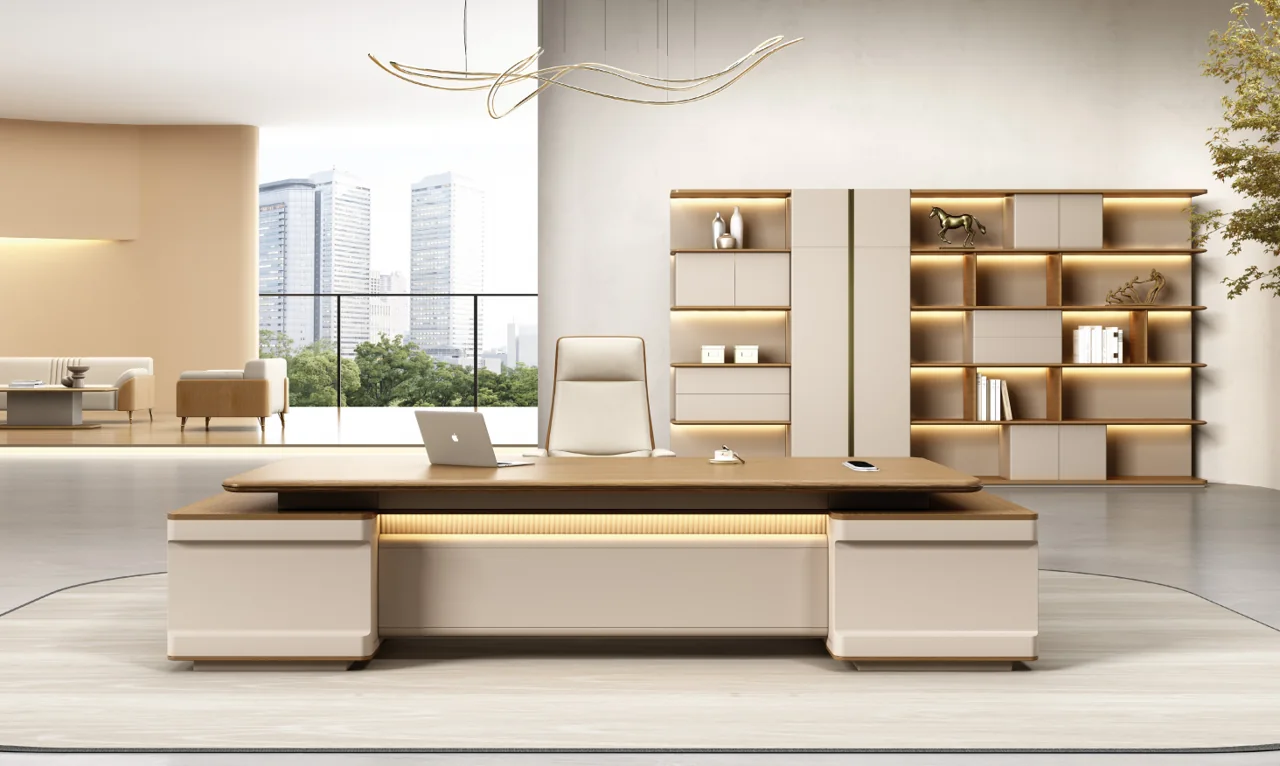
Approve an executive-desk allowance against defined alternatives rather than an unspecified range name. The Gelaimei examples below have a 2000 mm second dimension, while the selected Senrui examples have a 1600 mm second dimension. Switching between them can alter the room layout and component scope as well as the quotation.
Catalogue examples and dimensions
| Catalogue range | Catalogue reference | Listed dimensions (mm) |
|---|---|---|
| Gelaimei | GLMA07-2420 | 2400 × 2000 × 750 |
| Gelaimei | GLMA08-2820 | 2800 × 2000 × 750 |
| Gelaimei | GLMA09-3220 | 3200 × 2000 × 750 |
| Senrui | SRA04-2216 | 2200 × 1600 × 750; 2000 × 1600 × 750 |
| Senrui | SRA02-1816 | 1800 × 1600 × 750; 1600 × 1600 × 750 |
Define what each budget option actually buys
List the selected desk reference, exact size, finish and components included in each option. Separate any storage, electrical accessory or service that still needs confirmation. An option called standard desk provides no stable basis for later approval if the intended return or cabinet was never defined.
GLMA07, GLMA08 and GLMA09 list 2400, 2800 and 3200 mm lengths respectively. SRA04 lists 2200 or 2000 mm, and SRA02 lists 1800 or 1600 mm. Select one length in each alternative rather than keeping several sizes inside one budget line.
Show the consequences outside the furniture price
Place each option on the measured room plan and identify changes to services, visitor seating and adjacent storage. Ask whether the smaller option still performs the intended work and whether the larger one creates additional site work. Do not equate a smaller outside rectangle with the same furniture functions at a lower cost.
Keep freight, destination handling, installation and other agreed services identifiable in the comparison. A desk allowance cannot be meaningfully compared with a different package that includes or excludes those items. Request order-specific commercial terms instead of inventing a catalogue price benchmark.
Record the choice and the limits of approval
Have the decision identify the selected option and any unresolved items that must be closed before production release. Distinguish approval of a planning allowance from acceptance of the final furniture drawing and sample. Changes in scope should remain visible when the costed offer replaces the allowance.
Retain the rejected options and the reason for the choice. If a later substitution is proposed to meet a budget, compare it with this accepted scope and room consequence. A model change should not silently become a different return, accessory or destination service package.
Questions before ordering
Does budget approval authorise production?
Only if the agreed process also closes the required drawing, sample and scope approvals. Record those milestones separately.
Can two options be compared by model name alone?
Specify selected dimensions, components, finishes and services for each.
Should destination costs sit inside an unspecified allowance?
Itemise the agreed scope and responsibilities so the alternatives can be reconciled.
What to include in the quotation request
- Selected reference and size for every option
- Included and excluded components and services
- Room and equipment consequences
- Decision record and remaining approval milestones
Catalogue basis and confirmation
The reference and dimension examples come from the 2026 Yiwan English catalogue, Gelaimei and Senrui. They support the purchasing comparison above. The selected components, materials and any required performance are confirmed through the supplier drawing and written order specification. Catalogue imagery is a design reference, not evidence of completed GulfForma projects.