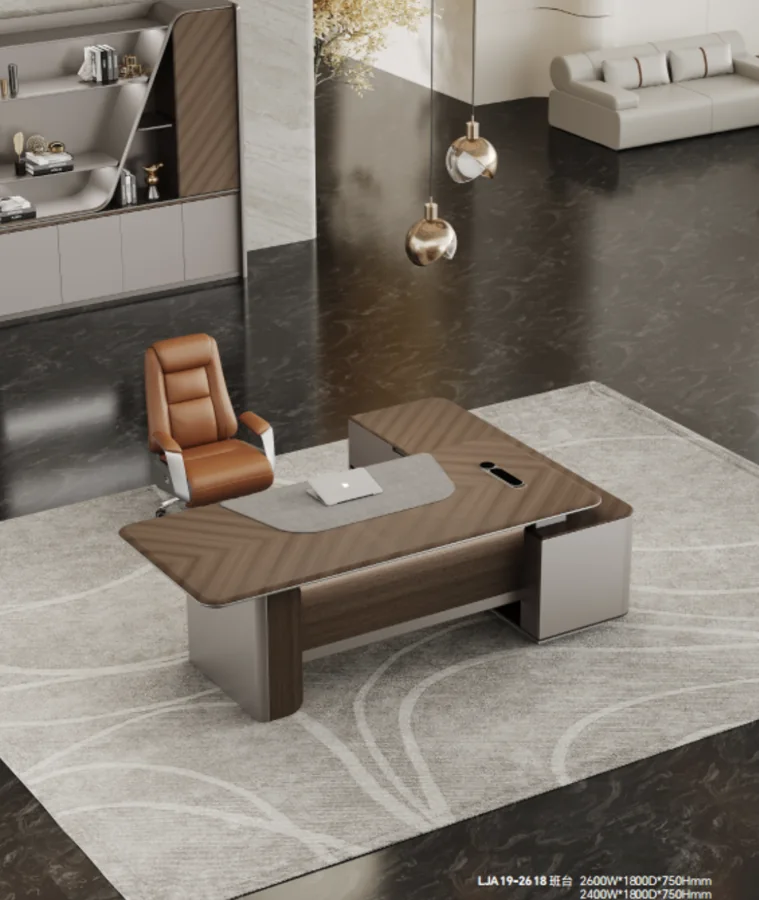
A mixed office desk order should explain the tasks behind each selected format. The Ruijie examples below range from 1200 × 600 mm straight-desk envelopes to larger 1600 or 1800 mm-deep arrangements. A job title alone does not establish the necessary top, return, storage or equipment scope.
Catalogue examples and dimensions
| Catalogue range | Catalogue reference | Listed dimensions (mm) |
|---|---|---|
| Ruijie | LJA17-1816 | 1600 × 1600 × 750; 1800 × 1600 × 750 |
| Ruijie | LJA18-2218 | 2000 × 1800 × 750; 2200 × 1800 × 750 |
| Ruijie | LJA19-2618 | 2400 × 1800 × 750; 2600 × 1800 × 750 |
| Ruijie | LJA15-1206 | 1200 × 600 × 750 |
| Ruijie | LJA16-1407 | 1400 × 700 × 750 |
Describe what happens at each working position
List equipment, documents, visitor discussions and storage that the role actually uses. Separate an everyday requirement from an occasional activity that can take place elsewhere. Ask whether the desk must hold equipment permanently or only provide a temporary surface.
Use those requirements to compare the small LJA15 and LJA16 entries with LJA17, LJA18 and LJA19. The larger outside envelope may suit a return arrangement, but it does not prove more usable storage or a particular number of visitors. Confirm those details on the supplier drawing.
Select the size at role and room level
LJA15-1206 and LJA16-1407 list 1200 × 600 and 1400 × 700 mm. LJA17 lists 1600 or 1800 mm lengths at 1600 mm depth; LJA18 lists 2000 or 2200 mm at 1800 mm depth; LJA19 lists 2400 or 2600 mm at 1800 mm depth. Heights are listed at 750 mm.
Assign one selected size to each room or position. Where two people have the same role but different rooms, keep the functional requirements common while checking the furniture fit separately. Avoid multiplying one management-desk size across every office without that check.
Approve the mix with a traceable quantity summary
Prepare position-level lines first, then consolidate quantities by exact model, selected dimensions and finish. Explain why each alternative was chosen so the budget reviewer can see which functions would change if the mix is revised. Keep storage and accessories itemised where their inclusion is not confirmed.
Retain a representative equipment layout or mock-up for each approved format. At delivery, use position labels to distribute the correct furniture. A mixed schedule is easier to maintain when the task brief, selected reference and room allocation remain connected.
Questions before ordering
Should every manager receive the largest desk?
Compare the actual work and room requirements. Title alone does not define a furniture specification.
Do the larger dimensions confirm more storage?
Request component and internal-storage details before relying on that assumption.
How can a mixed order stay easy to compare?
Use position-level requirements and sizes, then consolidate exact matching references into a summary.
What to include in the quotation request
- Task and equipment brief for each role
- Selected size and component scope per position
- Room allocation and consolidated quantities
- Representative layout or mock-up approval
Catalogue basis and confirmation
The reference and dimension examples come from the 2026 Yiwan English catalogue, Ruijie. They support the purchasing comparison above. The selected components, materials and any required performance are confirmed through the supplier drawing and written order specification. Catalogue imagery is a design reference, not evidence of completed GulfForma projects.